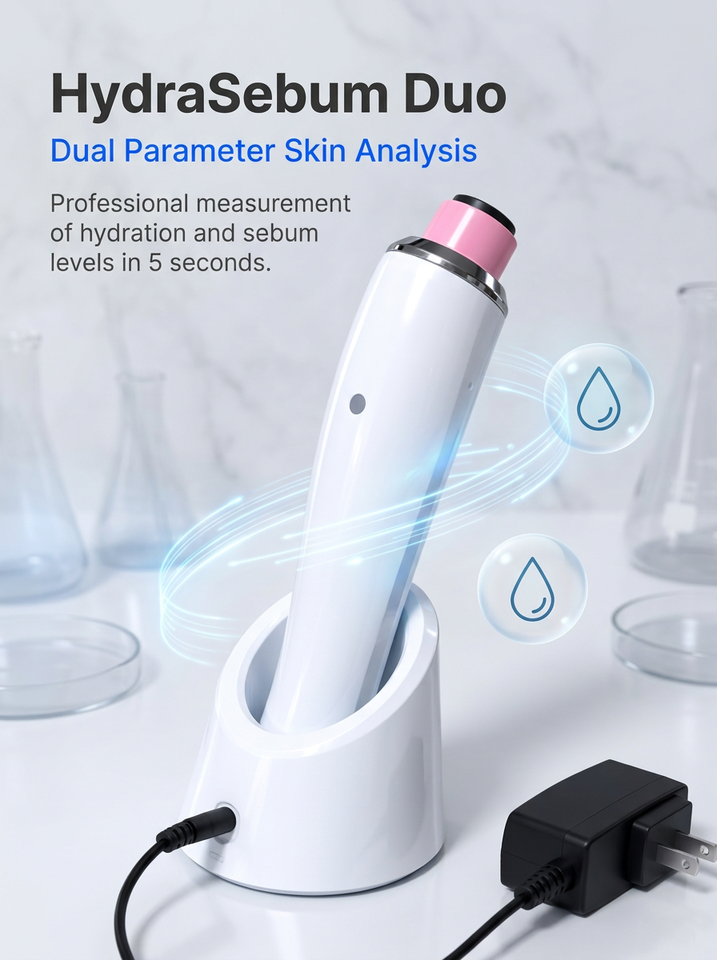


Product Introduction
1. Product Positioning
Labodorf HydraSebum Duo is a professional integrated skin hydration‑sebum testing instrument compliant with T/GDCA 008‑2021 Human Subject Testing Methods for Moisturizing and Oil‑Control Performance of Cleansing Products. Designed for cosmetic efficacy evaluation on human subjects, it supports human-subject tests for cleansing, moisturizing, oil-control and skin-barrier-related skincare products. It enables standardized comparative analysis at fixed measurement sites and simultaneously captures two core skin biomarkers: skin hydration and sebum content. It eliminates judgement limitations caused by purely subjective skin-feel feedback (e.g., post-cleansing freshness or tightness). Its operation also follows environmental and operational specifications defined in the EEMCO Guidelines for Electrical Measurement of Skin Hydration.
2. Measurement Principles
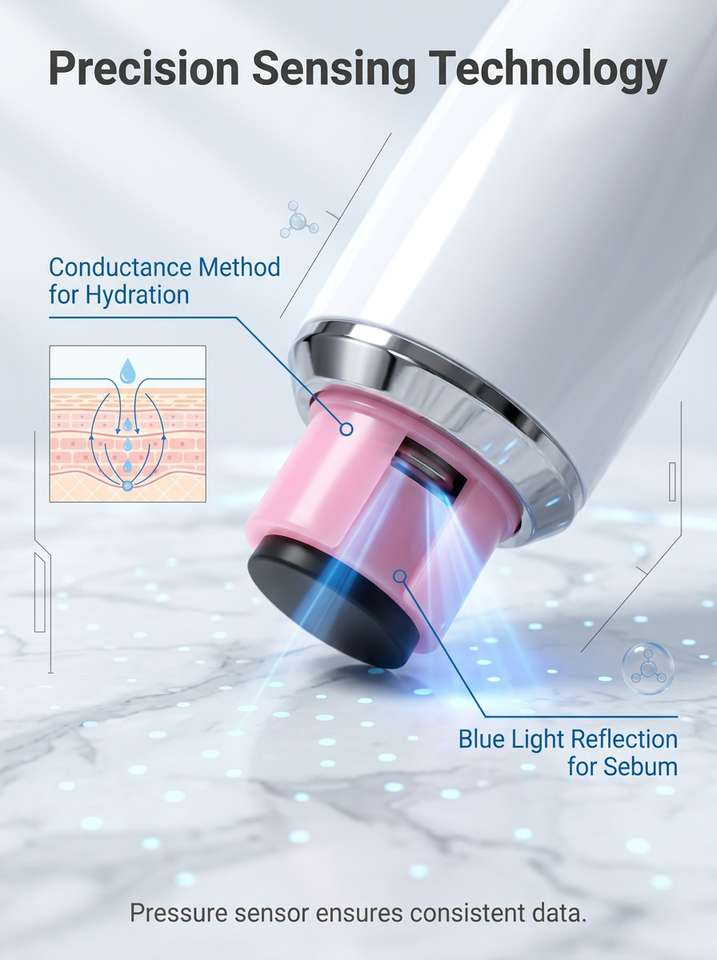
- Sebum (skin oil) measurement: reflectance-photometer method Built-in blue-light LEDs project light onto the skin surface. The instrument measures the intensity of reflected light. Sebum concentration alters reflected-light intensity, and sebum content is calculated from these intensity variations.
- Stratum corneum hydration measurement: skin‑surface electrical‑conductivity method Skin‑surface electrical conductivity is measured to compute stratum corneum water content. A key advantage of this principle is its capacity to capture subtle hydration fluctuations even at high skin‑moisture levels, offering better sensitivity than many alternative hydration‑detection solutions.
Three mainstream sebum‑testing principles in the industry for reference: transmission‑photometer method (Sebumeter), reflectance‑photometer method (HydraSebum Duo), and microbalance method (SebumScale). This device adopts the reflectance‑photometer approach.
3. Hardware and Connectivity
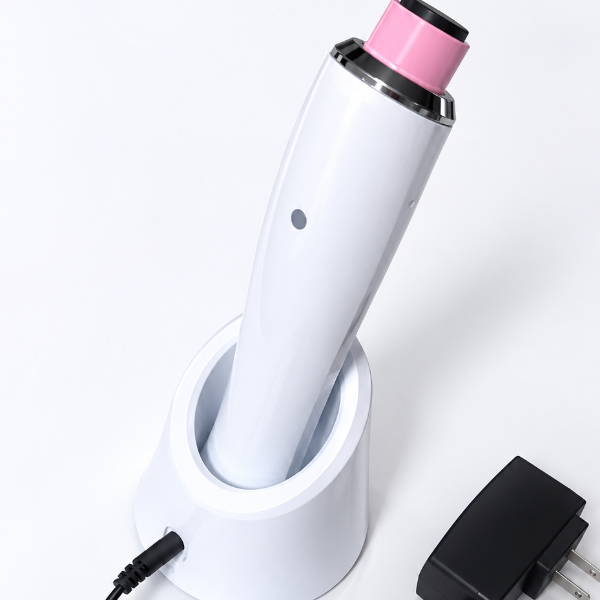
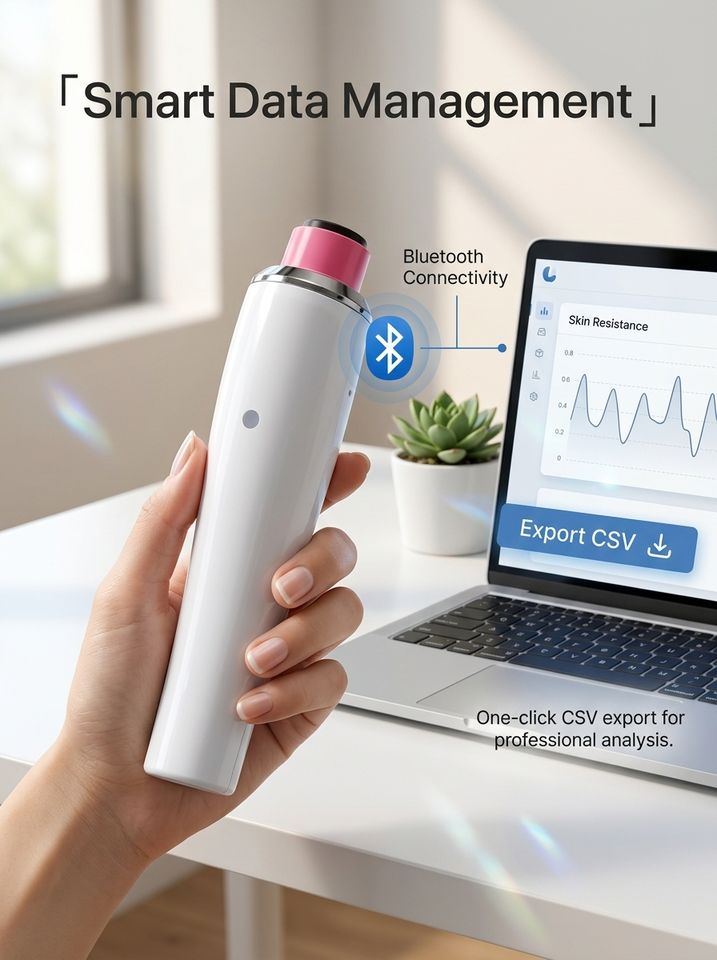
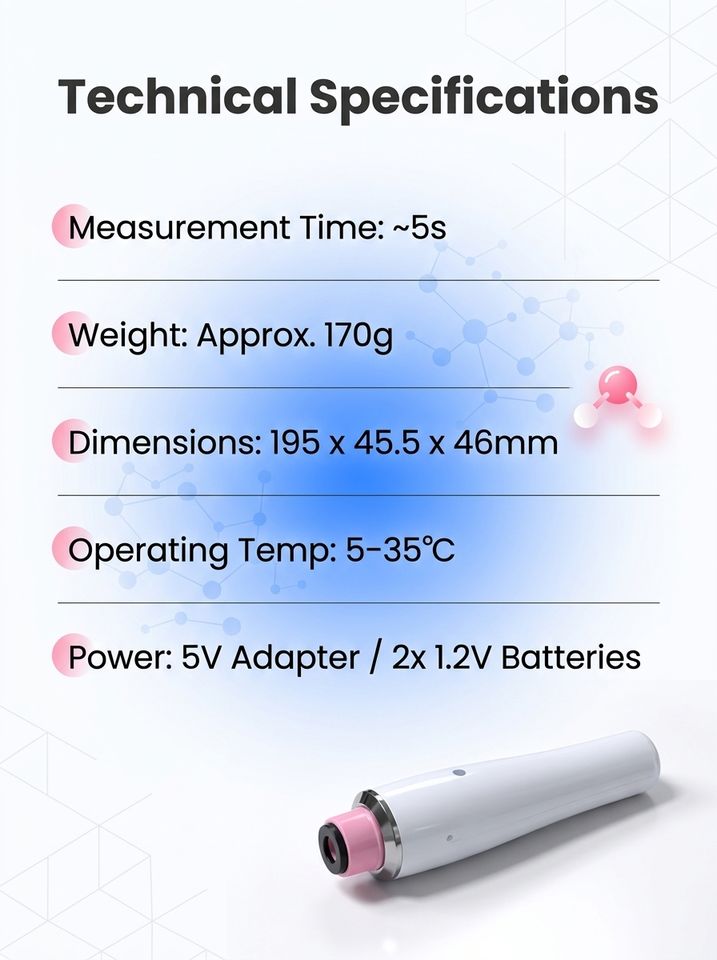
- Handheld probe unit powered by internal batteries; communicates with computer software via Bluetooth. Users select the corresponding COM port on PC software to establish connection.
- Sensor probe: Before each test, wipe the sensor with a dry soft cloth to remove residual water, sweat, skincare residues and oil stains that may interfere with test results.
- Status indicator lights:
- Rapid‑flashing green light: measurement‑in‑progress
- Solid blue light: measurement completed; data transmitted to software.
4. Standard Test Procedures
4.1 Subject and Environmental Requirements
Test environment: temperature 20‑22 °C, relative humidity 40‑60 %. Subjects shall acclimatize inside this environment for 15‑30 minutes prior to formal testing. Measurements must not be performed immediately after exercise, sweating or face‑washing. Testers shall record subject skin type, time of last cleansing, cosmetic/skincare usage status and designated measurement sites.
4.2 Measurement Sites
- Sebum measurement: 3 cm × 3 cm area on the forehead.
- Hydration / transepidermal water loss (TEWL) measurement: 3 cm × 3 cm area on cheek and zygomatic region.
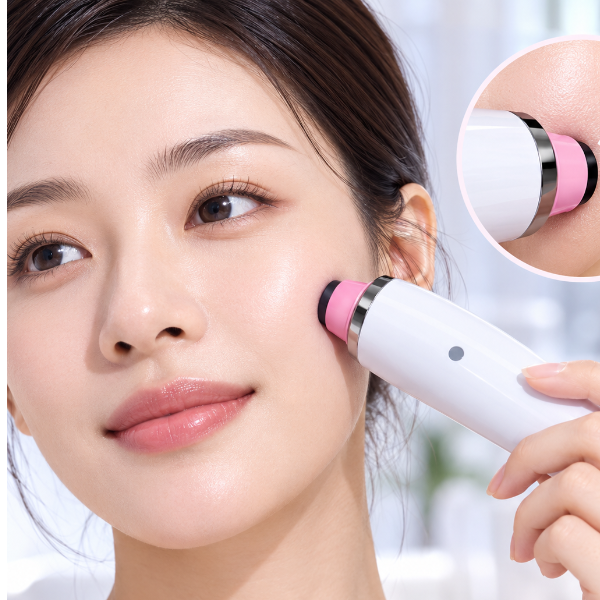
Critical operational note: The probe must lie flat against skin with constant contact pressure. Inconsistent pressure, timing or anatomical sites will produce incomparable datasets, representing one major pain point in skin hydration‑sebum testing.
4.3 Software Data Logging
The software automatically records: skin hydration value, sebum value, ambient temperature, ambient humidity, probe contact pressure.
Readings showing zero values, extreme fluctuations or probe slippage shall be discarded, and the measurement must be repeated. Replicate measurements are supported at each test point. Subject information, test site, sample name and timestamp are saved simultaneously. The software visualizes facial measurement locations and exports datasets for statistical significance analysis (P<0.05 threshold for moisturizing / oil-control efficacy judgement).
5. Application Scenarios and Efficacy‑Judgement Logic
Primarily deployed for human‑subject cosmetic efficacy trials for cleansers, moisturizers and oil‑control skincare products.
- Moisturizing efficacy judgement: The test product is deemed moisturizing at the tested time-point if post-application hydration / TEWL parameters are statistically superior to baseline pre-application values, or significantly better than control-group results (P < 0.05). Otherwise, no moisturizing efficacy is confirmed.
- Oil‑control efficacy judgement: The test product delivers oil‑control effect at the tested time‑point if post‑use sebum content is statistically lower than pre‑use baseline, or significantly lower than control‑group outcomes (P < 0.05). Otherwise, no oil‑control efficacy is confirmed.
Core requirement: Oil‑control assessment cannot rely solely on sebum reduction. Skin hydration must be monitored in parallel, to rule out excessive cleansing that depletes skin moisture and induces tightness and dryness. Subjective sensory bias from individual test‑subject perceptions must also be avoided.
6. Solved Industry Testing Pain Points
Addresses three common challenges in skin-biometrics testing:
- Replaces visual inspection and tactile subjective evaluation with objective numerical readouts for before-after comparison, eliminating deviations caused by lighting, ambient conditions and personal sensory differences.
- Measures hydration and sebum simultaneously. Evaluators will not overlook moisture loss while focusing only on sebum reduction.
- Records contact pressure, locks measurement sites and standardizes environmental conditions to control variables, ensuring comparability for pre‑post and inter‑group datasets.
7. Data Visualization Outputs
Generates a 2-dimensional hydration-sebum coordinate chart. The horizontal hydration axis ranges from 0-1500 units; the vertical sebum axis ranges 0-1500 units. The 9-grid diagram classifies skin phenotypes: dry skin, normal skin, oil-prone skin and multiple sensitive-skin subtypes with descriptive trait annotations for each skin category.